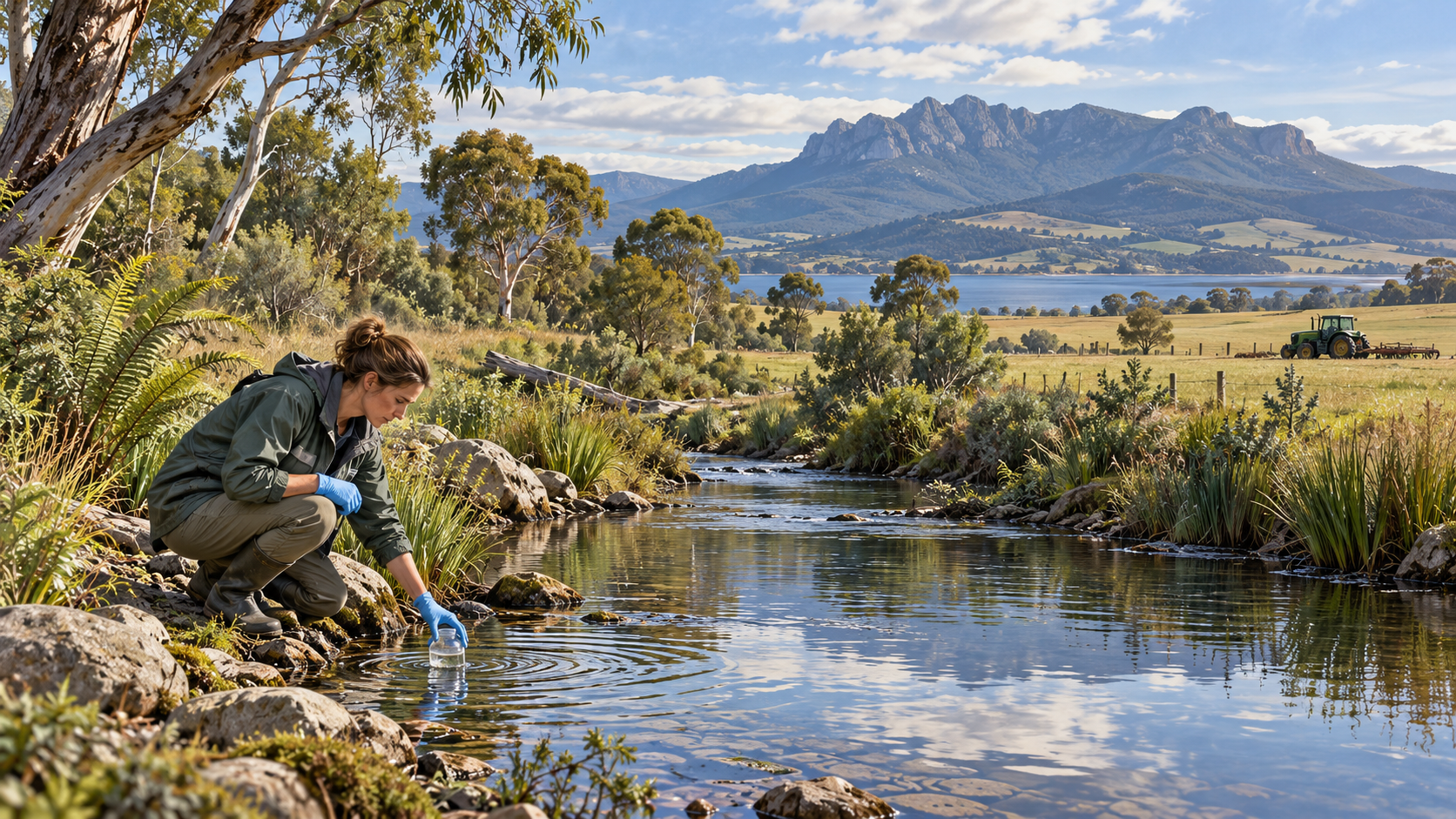
Atrazine has a documented Tasmanian forestry connection. New Australian decisions on paraquat and diquat make chemical oversight a timely public-interest issue.
If a pesticide has lost approval overseas but remains available in Australia, the public is entitled to a clear explanation. For Tasmania, the discussion should also establish where it is used, who may be exposed and how the effectiveness of local safeguards is checked.
There is a current reason to revisit the issue. On 23 June 2026, Australia’s regulator, the APVMA, decided that paraquat and diquat could remain available with substantial new restrictions. It identified acute risks to users and risks to birds and mammals as reasons for tighter controls.[1]
The most direct Tasmanian connection found for this article concerns another herbicide: atrazine. NRE Tasmania’s information page, last published in April 2024, identifies its use in forestry to establish conifers such as radiata pine.[2] That is evidence of a recognised local use, but it is not a 2026 inventory of where or how much is being applied.
Four chemicals worth examining
“Banned overseas” needs precision. A country may withdraw approval for an active substance, prohibit particular uses or impose a transition period. The comparison below identifies the decisions, rather than implying a worldwide ban or unrestricted Australian use.
| Chemical | European decision | Australian position and Tasmanian relevance |
|---|---|---|
| Atrazine | EU authorisations withdrawn under a 2004 decision, with groundwater protection central to the assessment.[3] | Retained in Australia with controls following review. NRE identifies Tasmanian forestry use.[2][4] |
| Paraquat | The European court annulled the EU authorising directive in 2007.[5] | Available subject to restrictions; property-level Tasmanian use not established here.[1] |
| Diquat | EU approval was not renewed in 2018; the decision identified risks to bystanders, residents and birds.[6] | Available subject to restrictions; Tasmanian application volumes not established here.[1] |
| Chlorpyrifos | EU approval was not renewed in 2020 following human-health concerns.[8] | Australia removed most agricultural and urban pest-control uses in its October 2024 decision, retaining limited uses. It is misleading to describe it as generally unrestricted.[7] |
What changed in Australia this year?
The new paraquat and diquat requirements include phasing out backpack sprayers, enclosed mixing and loading systems, stronger personal protection and changes to permitted uses and application rates. New labels apply to newly manufactured products, while existing stock has a two-year phase-out period.[1]
The APVMA did not find that approved paraquat uses increase Parkinson’s disease risk. This regulatory assessment does not settle the cause of any individual’s illness.[1]
The transition matters. A public update should explain which requirements apply now and which are being phased in. The applicable product label, permit and official decision determine the authorised use; a general news article cannot substitute for those conditions.
Atrazine creates a specific local question
The EU’s 2004 decision concerned the inability to demonstrate adequate protection of groundwater from atrazine and its breakdown products.[3] Australia’s review retained the chemical with measures intended to reduce entry into waterways, including restrictions around water sources and changes to labels.[4]
The useful Tasmanian follow-up is therefore concrete: obtain recent use figures, identify relevant catchments and publish monitoring results with enough context to assess the controls. This research did not establish a current statewide usage total or a recent statewide pattern of harmful exposure. Those gaps should be investigated rather than filled with assumptions.
A monitoring report should distinguish a chemical detection, an exceedance of a relevant guideline and evidence of actual harm. It should identify sampling dates, locations, test sensitivity and the standard used for comparison. Raw-water findings should also be kept distinct from results for treated drinking water.
Protect workers, neighbours and farming livelihoods
Tasmania already has a ground-spraying code that sets responsibilities and minimum standards.[9] A useful review would assess compliance, complaint handling and whether nearby residents receive the information they need.
Possible improvements include a public register of high-concern chemicals and their status, aggregated annual use reporting, targeted monitoring and clear triggers for reviewing overseas regulatory decisions. Where a use is to be withdrawn, support for safer and effective alternatives should be part of the plan.
Accuracy also means correcting overstatements. Glyphosate, for example, is not subject to an EU-wide ban: the European Commission renewed its approval until December 2033, subject to conditions.[10] Individual national restrictions need to be identified separately.
Tasmania’s next step should be an evidence-based account of chemical use and exposure, with the results open to public scrutiny. Farmers, forestry workers and nearby communities all have an interest in controls that work in practice and in knowing when stronger measures are needed.
Sources and further reading
Information checked on 8 October 2026. Policy proposals in this article are presented for discussion.
- APVMA: final paraquat and diquat review decisions, 23 June 2026
- NRE Tasmania: atrazine information, last published 9 April 2024
- European Commission: Decision 2004/248/EC withdrawing atrazine authorisations
- APVMA: atrazine review and continuing controls
- Court of First Instance: paraquat authorisation annulled, 11 July 2007
- European Commission: Regulation 2018/1532, non-renewal of diquat approval
- APVMA: chlorpyrifos final regulatory decision, 3 October 2024
- European Commission: chlorpyrifos and chlorpyrifos-methyl non-renewal
- NRE Tasmania: Code of Practice for Ground Spraying
- European Commission: glyphosate approval renewed until 15 December 2033