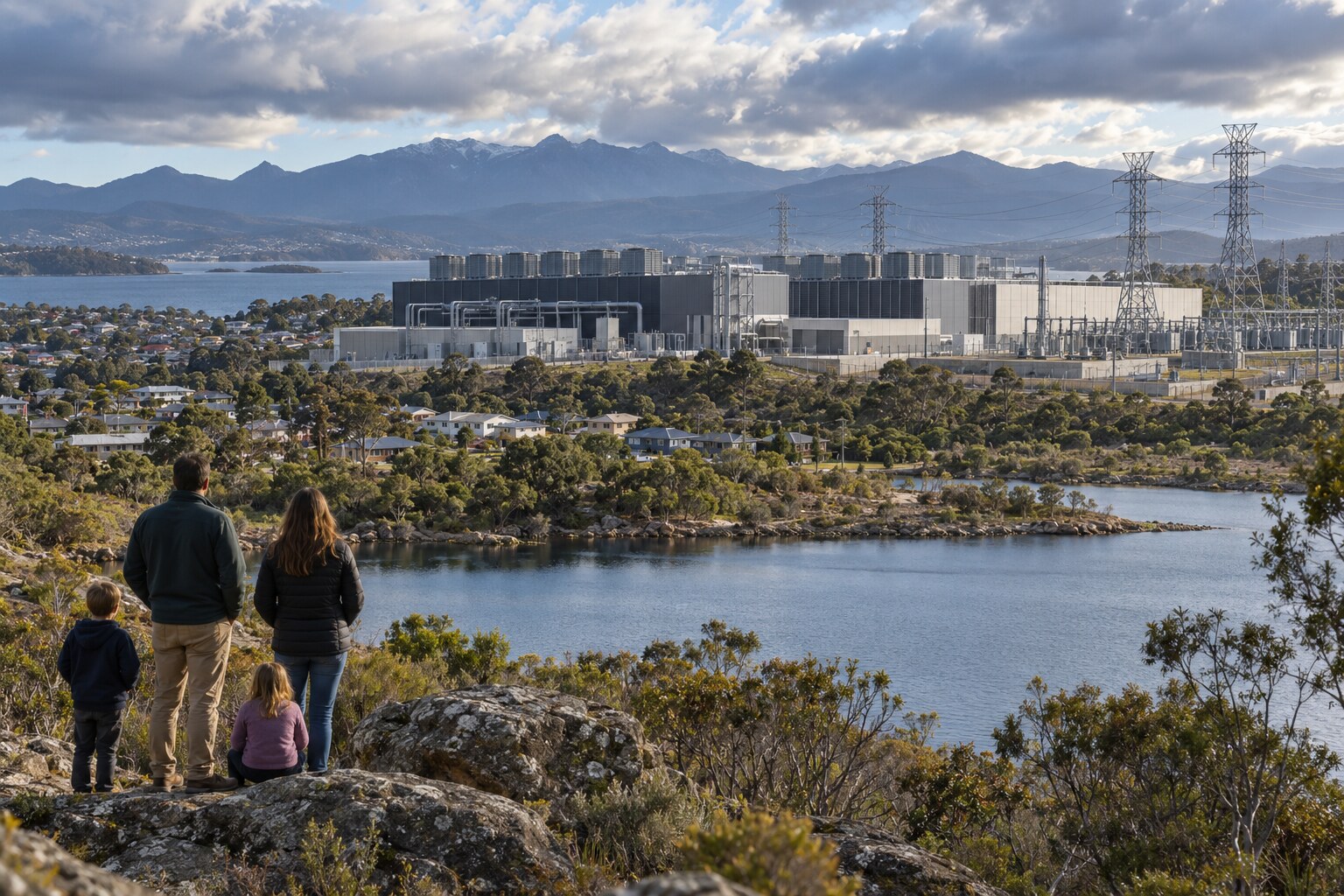
AI Data Centres: Tasmania Must Know the Real Cost Before Approval
Artificial intelligence may operate in the digital world, but the infrastructure supporting it consumes real electricity, real water and real land.
Large AI data centres are industrial facilities filled with powerful computer servers operating around the clock. Those servers produce heat and must be continuously cooled. The facilities can require major electricity connections, cooling systems, backup power, water infrastructure and large buildings containing equipment that may become obsolete much faster than traditional public infrastructure.
Data centres may bring investment, construction work and technical employment. Tasmania should be open to new industries—but only where the benefits are genuine, the costs are fully disclosed and essential resources are protected.
Calling Tasmania’s electricity “renewable” does not make it unlimited. The Tasmanian Government has legislated a target of producing 21,000 gigawatt hours a year by 2040, equal to twice the state’s 2020 electricity demand. New large industrial loads must therefore be assessed against the generation, transmission and storage required to supply them reliably.
If new infrastructure is required primarily for a private development, Tasmanians must be told who will pay for it. Households and existing businesses should not face higher bills, reduced reliability or public borrowing so that a private operator can secure a favourable energy arrangement.
Water use must be equally transparent. Some data centres use water-intensive cooling, while others use closed-loop, air-cooled or hybrid systems. A proposal should never be assessed using vague statements about “efficient cooling.” It should disclose the maximum daily and annual water demand, the source of that water, expected losses through evaporation, treatment chemicals and what happens during drought or unusually hot conditions.
The Australian Government’s expectations for data centres now expressly include supporting the clean-energy transition and using water sustainably and responsibly. These principles should be enforceable conditions in Tasmania—not optional aspirations.
Communities also need protection from continuous mechanical noise, low-frequency sound, heat discharge, bright security lighting, diesel backup generators, battery risks, heavy construction traffic and the cumulative effect of several developments drawing from the same electricity and water systems.
Promises of employment must be tested carefully. Construction can create significant short-term work, but highly automated facilities may employ fewer permanent local workers than the size and resource consumption of the development initially suggest.
What needs to change
- Every proposal must disclose its maximum electricity demand, average demand and expected growth over the life of the facility.
- Developers must identify all generation, transmission, substations, batteries and backup power required—and who will pay for them.
- Maximum daily and annual water use must be published, including the source, cooling method, evaporation losses and drought plan.
- Cooling and fire-control chemicals must be disclosed, with safety data sheets and enforceable waste-management plans.
- Independent assessments must examine noise, low-frequency sound, waste heat, lighting, air emissions, traffic, biodiversity and proximity to homes.
- Separate power, water or transmission developments required for the data centre must be assessed alongside it, not hidden in later applications.
- Public subsidies, tax concessions, discounted power arrangements and government guarantees must be disclosed before approval.
- Claims about permanent employment and economic benefits must be independently verified.
- Approvals must include measurable limits, continuous monitoring, public reporting and meaningful penalties for breaches.
- Operators must lodge a bond sufficient to cover decommissioning, waste removal and site rehabilitation.
Tasmania should not reject technology simply because it is new. Nor should it surrender essential resources simply because a project carries the fashionable label of artificial intelligence.
If a data centre is genuinely good for Tasmania, its developer should have no difficulty disclosing its full resource use, public cost and environmental impact before approval is granted.